




Vancouver has the slowest construction cost growth of any major city in Canada according Statistics Canada’s second quarter 2026 data, released July 24, 2026.
If you’ve been reading the tariff headlines and bracing for your BC project budget to blow up, the provincial numbers tell a different story. Metals are up, and meaningfully so. Almost everything else in BC has stayed flat or slow. And the one cost increase you can actually count on this year isn’t a tariff at all, it’s a provincial tax that takes effect October 1.
Here’s what the data actually shows, and what to do with it.
Key Takeaways
- Vancouver posted the smallest non-residential cost increase of any Canadian metro in Q2 2026, at 0.2 percent, with Victoria at 0.9 percent, against a national average of 1.4 percent.
- Metal costs are climbing everywhere. Structural steel framing rose 2.2 percent and metal fabrications 2.0 percent nationally in Q2 2026.
- BC’s economy is flat: ICBA Economics is forecasting 1.1 percent real GDP growth for BC in 2026, which typically means tighter bidding and better pricing for owners.
- Starting October 1, 2026, BC PST applies to architectural and engineering services at an effective rate of 2.1 percent of the full fee.
- BC contractors now put securing new projects and declining margins ahead of labour shortages as their top concerns.
- BCCA’s advice on tariffs is blunt: do not bid or sign without clear duty provisions in the contract.
What BC construction cost data actually shows in 2026
Statistics Canada publishes the Building Construction Price Index quarterly, broken out by metro area. Vancouver and Victoria both show up in it, making this the only regularly published, BC-specific measure of what it actually costs contractors to put up a building: materials, labour, equipment, overhead, and profit all included.
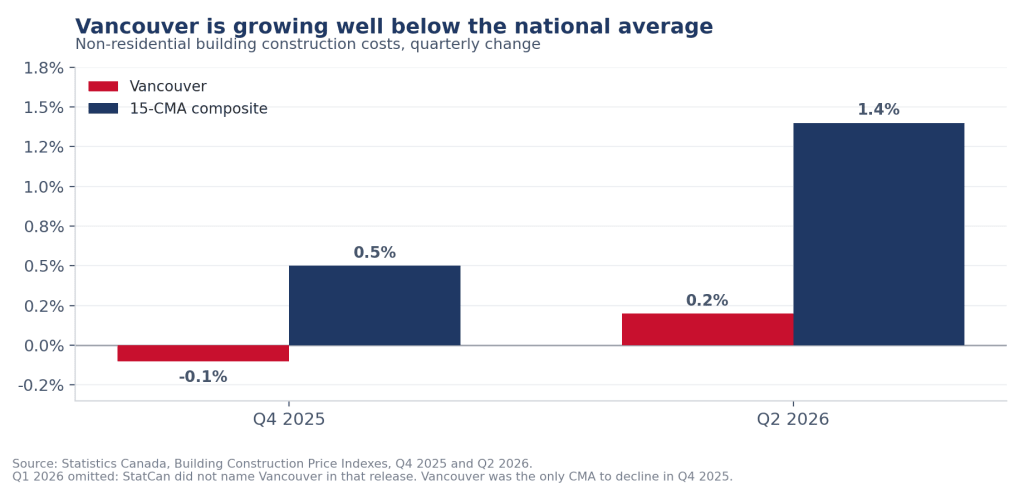
The Q2 2026 release shows non-residential construction costs up 1.4 percent nationally for the quarter and 3.5 percent year over year. Vancouver came in at just 0.2 percent, the lowest of any CMA measured, with Victoria at 0.9 percent. Compare that to Quebec City at 2.7 percent, Saskatoon and London at 2.1 percent, and Montreal at 1.9 percent.

This isn’t a one-off. Back in Q4 2025, Vancouver was the only CMA in Canada where non-residential construction costs actually fell, down 0.1 percent, with Victoria flat. BC has spent three straight quarters at or near the bottom of the national table.
Some context, though. ICBA chief economist Jock Finlayson’s analysis of the same StatCan series shows non-residential construction prices up 42 percent nationally since 2019, with BC and Alberta tracking close to the national figure. Costs are high across the board. They just aren’t accelerating in BC the way they are elsewhere.
Which materials are driving the increases?
Metals, consistently, and StatCan says so outright. In Q2 2026, the structural steel framing division rose 2.2 percent and metal fabrications 2.0 percent. Back in Q4 2025, StatCan attributed the same two divisions specifically to “the upward price pressure associated with import tariffs.”

That tariff picture is federal and cross-border, so there’s no BC-specific version of it. The US raised Section 232 tariffs on steel and aluminum to 50 percent in mid-2025 and added a 50 percent tariff on semi-finished copper from August 1, 2025. Canada answered with reduced steel tariff-rate quotas and a 25 percent surtax on many steel derivative goods from December 26, 2025, keeping the CUSMA carve-out for US and Mexican-origin material.
What isn’t driving the increases matters just as much. StatCan’s Q2 2026 data puts finishes and wood, plastics and composites at 0.5 percent, the smallest movement of any division. Altus Group reports lumber and wood products softening as post-pandemic oversupply worked itself out, and in Vancouver specifically, formwork, reinforcing steel, excavation, and glazing have all come down.
On lumber, read the duty numbers carefully. BC softwood entering the US now faces substantial combined anti-dumping and countervailing duties plus a 10 percent Section 232 tariff from October 14, 2025, but those are duties on what leaves BC, not on what you pay here. Restricted access to the US market has actually kept more BC supply at home, which is part of why domestic lumber pricing has eased.
One new pressure in Q2 2026 has nothing to do with tariffs. StatCan attributes much of the quarter’s increase to higher oil and fuel prices driven by geopolitical tension, which hits earthwork, equipment-heavy scopes, and material transport. Worth watching.
The BC cost increase nobody is budgeting for yet
Effective October 1, 2026, BC PST applies to architectural, engineering, and geoscience services. Under Provincial Sales Tax Notice 2026-001, the 7 percent rate applies to 30 percent of the purchase price, giving an effective rate of 2.1 percent on the full fee. The Architectural Institute of BC has confirmed the date. This one is BC-only, certain, and dated. Unlike tariffs, there’s no forecasting involved. Say your consultant fees run 8 percent of a 5 million dollar project: that’s roughly 400,000 dollars in design fees and about 8,400 dollars in new PST. Not a huge number on its own, but it’s a real line item most 2026 pro formas were built without.

The practical move here is simple: if your design work can reasonably be contracted and invoiced before October 1, that portion falls outside the new tax. Talk to your consultant team now, not in September.
What BC contractors are reporting
The BC Construction Association’s Spring 2026 Stat Pack puts the provincial industry at more than 264,000 people, 28.5 billion dollars a year, and 9.2 percent of BC’s GDP, with roughly 145 billion dollars in active projects right now. It’s a large industry operating in a slow economy.
ICBA Economics forecasts 1.1 percent real GDP growth for BC in 2026, with housing starts falling from 42,200 to 34,500. ICBA President Chris Gardner described it as “essentially a flatline.” The counterweight is BC’s major project inventory, which ICBA puts at 385 billion dollars total with 176 billion under construction.
For owners, a flat economy actually isn’t bad news. In ICBA’s December 2025 survey of more than 400 BC members, securing new projects and declining margins ranked ahead of worker shortages as the top concerns. Contractors fighting harder for fewer projects means sharper bids for you. Altus Group arrives at the same conclusion from a different angle, noting that a shovel-ready project in Vancouver can currently achieve competitive trade pricing below budget.
How does Gibraltar plan around this?
We price tariff exposure at the estimating stage, not at procurement. On steel, glazing, and metal-heavy mechanical and electrical scopes, we lock in firm supplier pricing early and buy out long-lead items before quotes expire. Where the spec allows, we offer alternates that hit the same performance with less tariff exposure.
We also flag the predictable costs owners tend to miss, like the October PST change, while there’s still time to sequence around them. On occupied or phased work, we sequence procurement so the budget is not held hostage to a single volatile material. Owners see where the cost sits, what is driving it, and what the alternatives cost. None of this removes tariffs. It removes the surprises.
What can BC owners do to protect their budget?
Start with the contract. BCCA’s guidance to BC contractors is unusually direct: do not bid and do not sign a contract without clear duty provisions, addressed in bid documents under GC 10.1 of CCDC 2. If your contractor hasn’t brought up duty provisions, ask why. BCCA has published member advisories on navigating tariff uncertainty that are worth reading from the owner side too.
Then the practical steps: use a price escalation clause that names covered materials, sets an adjustment trigger, and includes a ceiling. Weight your contingency toward metal scopes instead of spreading it evenly. Get design work under contract before October 1 where you can. Make procurement decisions quickly so locked pricing doesn’t expire. Start the contractor conversation before drawings are final, so cost intelligence shapes the design instead of reacting to it.
For benchmarking, Altus Group’s 2026 Canadian Cost Guide is the reference the industry actually uses, with hard cost data by asset class and city drawn from more than 6,500 development projects. Use a Vancouver figure for a Vancouver project, national averages are close to useless in 2026.
The bottom line
BC is currently the cheapest place in Canada to watch your construction costs go up. Strange thing to write, but it’s what the data says: Vancouver at 0.2 percent and Victoria at 0.9 percent are the two slowest-growing markets in the country. Metals are the real exposure, and they are concentrated in specific scopes you can identify and price early.
If your project is metal-light, this is a good market, and waiting just costs you money. If it is metal-heavy, the exposure is real and it belongs in the estimate, not the change order. Either way: know your material mix, lock the volatile scopes, get your duty provisions in writing, and sort your design contracts before October. Gibraltar builds across BC and Alberta and prices this market every day.
Frequently Asked Questions
Slowly, and more slowly than anywhere else in Canada. Statistics Canada’s Q2 2026 data shows Vancouver’s non-residential construction costs up 0.2 percent in the quarter and Victoria up 0.9 percent, against a national average of 1.4 percent. Back in Q4 2025, Vancouver was the only Canadian metro where costs fell.
Metals. Statistics Canada identifies structural steel framing and metal fabrications as the fastest-rising divisions, and it attributes the pressure directly to import tariffs. Anything with significant metal content feels it, including mechanical and electrical equipment. Finishes, wood products, and concrete have moved far less.
From October 1, 2026, BC PST applies to architectural, engineering, and geoscience services. Under PST Notice 2026-001, the 7 percent rate applies to 30 percent of the purchase price, an effective 2.1 percent on the full fee. It is BC-specific and it affects every project with a consultant team.
Yes. StatCan’s Q2 2026 data shows finishes and wood, plastics and composites growing at just 0.5 percent, the slowest-moving divisions in the index. In Vancouver specifically, Altus Group reports formwork, reinforcing steel, excavation, and glazing all softening as the condo tower segment cooled.
Get duty provisions into the contract. BCCA advises BC contractors to address them in bid documents under GC 10.1 of CCDC 2. Add a price escalation clause that names covered materials and adjustment triggers, weight your contingency toward metal scopes, and buy out long-lead metal items before pricing expires.


